How to Cure Migraine by Ayurveda
 7
A prolonged pounding headache, nausea, and photophobia are just some of the debilitating effects of a migraine attack experienced by a large number of the population, particularly women.
And while most may try to rest and wait it out, some try to power through with the help of painkillers. Unfortunately, nothing really provides consistent and effective relief.
This is where Ayurveda comes in.
With a truly holistic and exceptionally-individualised approach to healing, Ayurveda offers the ideal pathway to migraine-free days and optimal health.
What exactly is a migraine?
A migraine is a type of headache that is characterised by regular episodes of intense and throbbing pain to one side of the head. However, migraines are not limited to head pain alone.
Migraine sufferers may also experience:
- Nausea and vomiting
- Sensitivity to light and sound
- Dizziness and vertigo
- Visual disturbances
- Fatigue and weakness
- Difficulty in speaking
- Neck pain
- Tingling or numbness
Needless to say, migraines render most people helpless and unable to function well in their day-to-day lives when struck by such a painful episode.
What causes migraines?
Though considered to be a neurological disorder, the exact cause of migraines is not yet clear. Some of the common triggers for migraines may include:
- Genetic factors
- Hormonal changes
- Environmental stimuli
- Stress
- Dietary factors
- Sleep disturbances
- Overuse of medications
- Physical exertion
As a result, migraines are generally thought to be caused by a combination of genetic, environmental, and neurological factors. However, understanding and identifying the exact cause or trigger is crucial in creating effective migraine management strategies.
Ayurveda and Migraines
In Ayurveda, migraines are often attributed to an imbalance in the three doshas, particularly the Pitta dosha (associated with the elements of fire and water); and any factor that aggravates or creates an imbalance of Pitta, could be a trigger leading to migraine headaches.
As such, some of the Ayurvedic perspectives on the causes of migraines include:
- An excess of Pitta- An increase in Pitta dosha, whether due to natural constitution (Prakriti) or external factors, can contribute to the heat and intensity associated with migraines.
- Accumulation of Ama (toxins)- The build-up of Ama, or toxins, in the body is considered a significant factor in Ayurveda. Poor digestion and improper lifestyle choices can lead to the accumulation of Ama, which, in turn, can contribute to Pitta imbalance and migraines.
- Dehydration- a lack of cooling and nourishing fluids in the body, can aggravate Pitta and contribute to migraines.
- Prolonged sun exposure- Prolonged exposure to the sun or excessive heat can increase Pitta and potentially trigger migraines.
- Dietary factors- Consuming Pitta-aggravating foods, such as spicy, oily, and acidic foods, can contribute to an increase in Pitta and potentially trigger migraines.
- Emotional stress- Emotional factors, such as stress, frustration, anger, and intense emotions, are considered to elevate Pitta and may contribute to migraines.
- Irregular lifestyle- Irregular daily routines, including irregular sleeping patterns and meal times, can disrupt the natural balance of the doshas and contribute to Pitta aggravation.
Ayurvedic Strategies for Migraine Relief
With the Ayurvedic notion that migraines are a consequence of imbalance in the doshas (specifically an aggravation of Pitta); treatment and prevention of migraines thereby hinges on bringing balance and harmony to an individual’s constitution. Some of the most effective Ayurvedic strategies and therapies to bring relief from migraines include:
1. Diet and Lifestyle Changes-
Making dietary and lifestyle modifications can go a long way in reducing Pitta and regaining balance in the doshas. Some ways to achieve this are:
- Consume cooling foods such as cucumber, watermelon, apples, and dates.
- Limit the intake of spicy, salty, and fried foods.
- Stay well-hydrated with cooling and refreshing beverages.
- Get adequate sleep.
- Establish a daily routine that aligns with the natural rhythms of the day and night.
- Eat meals at regular times.
- Avoid prolonged and direct sun exposure.
2. Herbal Remedies-
Ayurvedic herbs and spices are essentially super foods that provide incredible health benefits. Ayurvedic herbs with cooling properties, such as coriander, mint, and aloe vera, may be used to support Pitta balance. Similarly, cumin and cardamom tea is an ideal post-meal drink that helps relieve nausea and stress. Cow ghee too, may be consumed with food, milk, or even utilised in Nasya.
3. Stress Relief-
Adopting stress-relieving practices is an excellent way of promoting Pitta balance. These may include:
- Meditation
- Pranayama (particularly Sheetali)
- Yoga (especially poses such as moon salutations, hidden lotus, child’s pose, boat pose, camel pose, and Uttanasana)

4. Panchakarma-
Traditional Ayurvedic detoxification therapies, known as Panchakarma, can help eliminate Ama and restore balance to the doshas. One such treatment, Virechan or therapeutic purgation, uses purgative substances to induce a cleansing bowel movement. This helps balance Pitta, improve digestion, and alleviate conditions associated with excess heat. Swedana, or herbal steam therapy, also helps in opening up the pores and eliminating toxins.
5. Abhyanga-
Abhyanga is a full-body oil massage using medicated oils. This therapy helps reduce excess heat, nourishes the skin, and promotes overall relaxation.
Migraines are painful, draining, and incapacitating episodes that severely affect the quality of a person’s day. But, despite millions suffering from them, there has, as yet, been little to no progress in finding an effective and lasting remedy for it. Except for the centuries-old wisdom of Ayurveda that is.
Ayurveda helps identify the triggers, manages the symptoms, and even provides lasting relief from migraines. All of this through simple but effective strategies that are easy to incorporate and provide incredible benefits to your physical, mental, and emotional wellbeing; helping you to achieve perfect health every day.
Suffering from recurrent migraines that affect the quality of your life? Visit The Ayurvedic Clinic today to consult with our experienced Ayurvedic practitioners and create the ideal individualised plan to find relief from the debilitating effects of migraines; all while bringing balance and harmony to your body and mind!
A prolonged pounding headache, nausea, and photophobia are just some of the debilitating effects of a migraine attack experienced by a large number of the population, particularly women.
And while most may try to rest and wait it out, some try to power through with the help of painkillers. Unfortunately, nothing really provides consistent and effective relief.
This is where Ayurveda comes in.
With a truly holistic and exceptionally-individualised approach to healing, Ayurveda offers the ideal pathway to migraine-free days and optimal health.
What exactly is a migraine?
A migraine is a type of headache that is characterised by regular episodes of intense and throbbing pain to one side of the head. However, migraines are not limited to head pain alone.
Migraine sufferers may also experience:
- Nausea and vomiting
- Sensitivity to light and sound
- Dizziness and vertigo
- Visual disturbances
- Fatigue and weakness
- Difficulty in speaking
- Neck pain
- Tingling or numbness
Needless to say, migraines render most people helpless and unable to function well in their day-to-day lives when struck by such a painful episode.
What causes migraines?
Though considered to be a neurological disorder, the exact cause of migraines is not yet clear. Some of the common triggers for migraines may include:
- Genetic factors
- Hormonal changes
- Environmental stimuli
- Stress
- Dietary factors
- Sleep disturbances
- Overuse of medications
- Physical exertion
As a result, migraines are generally thought to be caused by a combination of genetic, environmental, and neurological factors. However, understanding and identifying the exact cause or trigger is crucial in creating effective migraine management strategies.
Ayurveda and Migraines
In Ayurveda, migraines are often attributed to an imbalance in the three doshas, particularly the Pitta dosha (associated with the elements of fire and water); and any factor that aggravates or creates an imbalance of Pitta, could be a trigger leading to migraine headaches.
As such, some of the Ayurvedic perspectives on the causes of migraines include:
- An excess of Pitta- An increase in Pitta dosha, whether due to natural constitution (Prakriti) or external factors, can contribute to the heat and intensity associated with migraines.
- Accumulation of Ama (toxins)- The build-up of Ama, or toxins, in the body is considered a significant factor in Ayurveda. Poor digestion and improper lifestyle choices can lead to the accumulation of Ama, which, in turn, can contribute to Pitta imbalance and migraines.
- Dehydration- a lack of cooling and nourishing fluids in the body, can aggravate Pitta and contribute to migraines.
- Prolonged sun exposure- Prolonged exposure to the sun or excessive heat can increase Pitta and potentially trigger migraines.
- Dietary factors- Consuming Pitta-aggravating foods, such as spicy, oily, and acidic foods, can contribute to an increase in Pitta and potentially trigger migraines.
- Emotional stress- Emotional factors, such as stress, frustration, anger, and intense emotions, are considered to elevate Pitta and may contribute to migraines.
- Irregular lifestyle- Irregular daily routines, including irregular sleeping patterns and meal times, can disrupt the natural balance of the doshas and contribute to Pitta aggravation.
Ayurvedic Strategies for Migraine Relief
With the Ayurvedic notion that migraines are a consequence of imbalance in the doshas (specifically an aggravation of Pitta); treatment and prevention of migraines thereby hinges on bringing balance and harmony to an individual’s constitution. Some of the most effective Ayurvedic strategies and therapies to bring relief from migraines include:

1. Diet and Lifestyle Changes-
Making dietary and lifestyle modifications can go a long way in reducing Pitta and regaining balance in the doshas. Some ways to achieve this are:
- Consume cooling foods such as cucumber, watermelon, apples, and dates.
- Limit the intake of spicy, salty, and fried foods.
- Stay well-hydrated with cooling and refreshing beverages.
- Get adequate sleep.
- Establish a daily routine that aligns with the natural rhythms of the day and night.
- Eat meals at regular times.
- Avoid prolonged and direct sun exposure.
2. Herbal Remedies-
Ayurvedic herbs and spices are essentially super foods that provide incredible health benefits. Ayurvedic herbs with cooling properties, such as coriander, mint, and aloe vera, may be used to support Pitta balance. Similarly, cumin and cardamom tea is an ideal post-meal drink that helps relieve nausea and stress. Cow ghee too, may be consumed with food, milk, or even utilised in Nasya.

3. Stress Relief-
Adopting stress-relieving practices is an excellent way of promoting Pitta balance. These may include:
- Meditation
- Pranayama (particularly Sheetali)
- Yoga (especially poses such as moon salutations, hidden lotus, child’s pose, boat pose, camel pose, and Uttanasana)
4. Panchakarma-
Traditional Ayurvedic detoxification therapies, known as Panchakarma, can help eliminate Ama and restore balance to the doshas. One such treatment, Virechan or therapeutic purgation, uses purgative substances to induce a cleansing bowel movement. This helps balance Pitta, improve digestion, and alleviate conditions associated with excess heat. Swedana, or herbal steam therapy, also helps in opening up the pores and eliminating toxins.
5. Abhyanga-
Abhyanga is a full-body oil massage using medicated oils. This therapy helps reduce excess heat, nourishes the skin, and promotes overall relaxation.
Migraines are painful, draining, and incapacitating episodes that severely affect the quality of a person’s day. But, despite millions suffering from them, there has, as yet, been little to no progress in finding an effective and lasting remedy for it. Except for the centuries-old wisdom of Ayurveda that is.
Ayurveda helps identify the triggers, manages the symptoms, and even provides lasting relief from migraines. All of this through simple but effective strategies that are easy to incorporate and provide incredible benefits to your physical, mental, and emotional wellbeing; helping you to achieve perfect health every day.
Suffering from recurrent migraines that affect the quality of your life? Visit The Ayurvedic Clinic today to consult with our experienced Ayurvedic practitioners and create the ideal individualised plan to find relief from the debilitating effects of migraines; all while bringing balance and harmony to your body and mind!
This 9 Exercises are very good for migraines


How to do Standing Forward Bend
- Start in Tadasana (Mountain Pose), the blueprint pose for all standing yoga poses. Press down through the four corners of your feet, paying particular attention to the big toe mounds and inner heels. Spin your inner thighs back toward the wall behind you. Lift your kneecaps to engage your thighs, and to protect against hyperextension in your knees.
- Place your hands on the front of your hip joints, and press into the hip creases. Draw the tops of your thighs back so that the top of your sacrum is tilting forward. When you palpate the hip creases, the tissue there should feel springy rather than taut.
- Begin to bend forward, keeping the sides of your hips over your ankles. Make sure you bend forward by tilting your pelvis forward, not by bending from the waist. If you can’t tilt your pelvis forward when your knees are straight, bend your knees so that you can move your pelvis and spine together.
- If your hamstrings are tight, place your hands on two yoga blocks on their highest height. Make sure you are not rounding the lumbar spine. If that means bending your knees, that is fine. The health of your spine, in particular the health of the intervertebral discs in your lumbar spine, is way more important than keeping your legs straight.
- If you are practicing this yoga pose with straight legs, make sure your weight hasn’t shifted back into your heels, and that your knees are slightly bent versus locked back.
- Once in the asana, think of reaching your ischial tuberosities (sit bones) up away from the ground, focusing on creating a stretch in the belly of your hamstring muscles. Bend your knees if you need to in order to reach your hips up and create a stretch in the backs of your legs.
- Stay for several breaths.
- To come out of Uttanasana, ground down firmly into your feet and rise back up to standing with a long spine, swinging your hips under your shoulders as you arrive again in Tadasana.
How to Do Bridge Pose in Yoga
 Bridge Pose — Setu Bandha Sarvangasana (SAY-too BAHN-duh shar-vahn-GAHS-uh-nuh) — is a beginning backbend that helps to open the chest and stretch the thighs. Its Sanskrit name comes from five different words:
- “Setu” — meaning “bridge”
- “Bandha” — meaning “lock”
- “Sarva” — meaning “all”
- “Anga” — meaning “limb”
- “Asana” — meaning “pose”
When you're in the pose, your arms and legs create a “locked bridge” with your body. This pose can be used as preparation for deeper backbends, or practiced with a block as a restorative pose.
Benefits of Bridge Pose
Bridge Pose opens the chest, heart, and shoulders. It stretches the spine, the back of the neck, the thighs, and the hip flexors (front hip joints). Because your heart is higher than your head in this pose, it is considered a mild inversion (less strenuous than other inversions, such as Headstand) and holds all the benefits of inversions: Relief from stress, fatigue, anxiety, headaches, insomnia, and mild depression.
Bridge Pose also calms the mind and is known to be therapeutic for individuals with high blood pressure. Because it opens the chest, it increases lung capacity, which is therapeutic for those with asthma.
Bridge Pose also stimulates the abdominal organs and thyroid glands, which improves digestion and helps to regulate metabolism. Because it revitalizes the legs and stretches the shoulders, it can be a particularly rejuvenating pose for those who spend the day sitting in front of a computer or driving. It is also a preparatory pose for Shoulderstand (Salamba Sarvangasana) and Upward Bow Pose (Urdhva Dhanurasana).
Cautions
Do not perform this pose if you have a neck or shoulder injury. Always work within your own range of limits and abilities. If you have any medical concerns, talk with your doctor before practicing yoga.
Instructions

- Lie on your back with your knees bent and feet on the floor. Extend your arms along the floor, palms flat.
- Press your feet and arms firmly into the floor. Exhale as you lift your hips toward the ceiling.
- Draw your tailbone toward your pubic bone, holding your buttocks off the floor. Do not squeeze your glutes or flex your buttocks.
- Roll your shoulders back and underneath your body. Clasp your hands and extend your arms along the floor beneath your pelvis. Straighten your arms as much as possible, pressing your forearms into the mat. Reach your knuckles toward your heels.
- Keep your thighs and feet parallel — do not roll to the outer edges of your feet or let your knees drop together. Press your weight evenly across all four corners of both feet. Lengthen your tailbone toward the backs of your knees.
- Hold for up to one minute. To release, unclasp your hands and place them palms-down alongside your body. Exhale as you slowly roll your spine along the floor, vertebra by vertebra. Allow your knees to drop together.
Modifications & Variations
Bridge Pose can be a great way to counteract the stress of sitting for long periods. It can also be used as preparation for deeper backbends or as a restorative pose for deep relaxation. To deepen or lighten the pose, try these simple changes to find a variation that works best for you:
- If you're having trouble keeping your hips lifted or to create a restorative version of the pose, place a block or bolster under your sacrum — the spot on your lower back directly above your tailbone — to support your pelvis. Allow your weight to rest on the block.
- If your shoulders are very tight, keep your hands alongside the body with your palms pressing into the mat rather than clasping your hands beneath your torso.
- For a greater challenge, try One-Legged Bridge Pose (Eka Pada Setu Bandha Sarvangasana): Come into the full version of the pose. Then, on an exhalation, draw your right knee in toward your chest. Inhale as you straighten your leg, extending your heel up toward the ceiling. Imagine your foot is flat against the ceiling and lift up even higher through your heel. Hold for up to 30 seconds, then release your foot to the floor with an exhalation. Repeat on the opposite side.
- More experienced students can try keeping the buttocks relaxed in the pose. Use only the thigh muscles to lift the hips.
- For a deeper internal experience in the pose, close your eyes and concentrate on your breath.
Tips
Practicing Bridge Pose can be both calming and rejuvenating for your mind and body. Keep the following information in mind when practicing this pose:
- When you are in the full version of the pose, do not force your shoulders away from your ears by tugging too hard. Doing so can overstretch your neck and cause injury.
- Keep your shoulder blades drawn together as you extend your arms beneath your torso.
- Do not turn your head to the right or left when you're in the pose. Doing so can cause neck injury.
- Never push your body to come deeper into the pose. Always work within your own means and abilities, and this might change every day. Some days you will lift your hips high; other days you might want to use a block. Let the daily differences in your flexibility and strength be a reminder to flow with your practice, instead of forcing it.
Bridge the Gap
Practicing Bridge Pose can be a potent lesson in learning to slow down and listen to your body. Your spine, shoulders, and thighs will tell you how far to take the pose. The less you push, the more the pose will open up. Turn your awareness inward and notice how your body releases its grip when you don't force it. Let your Bridge be a connection between your body, mind, and spirit.
Benefits of Child's Pose
Child's Pose helps to stretch the hips, thighs, and ankles while reducing stress and fatigue. It gently relaxes the muscles on the front of the body while softly and passively stretching the muscles of the back torso.
This resting pose centers, calms, and soothes the brain, making it a therapeutic posture for relieving stress. When performed with the head and torso supported, it can also help relieve back and neck pain. Sometimes used as a counter-pose to backbends, Child's Pose restores balance and equanimity to the body.
Regular practice of Child's Pose also teaches conscious exploration of the breath. As the front of the body releases onto the thighs, the frontal ribs and abdominal muscles become slightly compressed. This restriction allows for a deeper opening of the back of the torso as the lungs expand behind the body. As this happens, keeping the breath slow, long, and steady allows for a new awareness of the breath's path through the front and back of the body.
Cautions
Do not practice Child's Pose if you have a current or recent knee injury. Women who are pregnant should only practice a wide-legged variation of the pose — do not press the belly on top of the thighs.
Always work within your own range of limits and abilities. If you have any medical concerns, talk with your doctor before practicing yoga.
Instructions
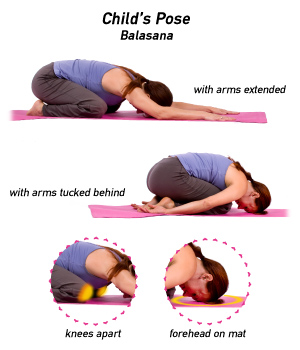
- Begin on your hands and knees. Center your breath, and begin to let your thoughts slow down. Turn your awareness inward.
- Spread your knees wide apart while keeping your big toes touching. Rest your buttocks on your heels.
- Those with very tight hips can keep their knees and thighs together.
- Sit up straight and lengthen your spine up through the crown of your head.
- On an exhalation, bow forward, draping your torso between your thighs. Your heart and chest should rest between or on top of your thighs. Allow your forehead to come to the floor.
- Keep your arms long and extended, palms facing down. Press back slightly with your hands to keep your buttocks in contact with your heels. Lengthen from your hips to your armpits, and then extend even further through your fingertips.
- For deeper relaxation, bring your arms back to rest alongside your thighs with your palms facing up. Completely relax your elbows.
- Let your upper back broaden. Soften and relax your lower back. Allow all tension in your shoulders, arms, and neck to drain away.
- Keep your gaze drawn inward with your eyes closed.
- Hold for up to a minute or longer, breathing softly.
- To release the pose, gently use your hands to walk your torso upright to sit back on your heels.
Modifications & Variations
Since Child's Pose is a resting position, it's important to make whatever modifications you need to feel comfortable, safe, and supported in the pose. Here are a few suggestions:
- If you have difficulty resting your buttocks on your heels, place a thickly folded blanket between the backs of your thighs and your calves.
- Spreading the knees wider apart can create a deeper stretch in the hips. Only spread your knees as wide as is comfortable for you — do not strain or force your body to extend deeper in this pose.
- Pad the tops of your feet with a blanket. You can also fold your mat for extra padding under your feet.
- Rest your forehead on a firm pillow, bolster, or stack of blankets. Alternatively, you can make fists and stack your hands, then rest your forehead on your stacked fists.
- Keeping your arms extended opens the shoulders and chest, but doing so makes the pose a bit more active. For a more restorative pose, rest your arms alongside your thighs.
Tips
Use Child's Pose throughout your practice whenever you need a break between poses or if you get out of breath. Return to the practice when you are ready.
Breathe consciously and fully into the back of your torso. Imagine your back is doming toward the ceiling, allowing the spine to lengthen and widen. With each exhalation, release your front torso a little deeper into the pose.
Relax & Let Go
Child's Pose is a simple way to calm your mind, slow your breath, and restore a feeling of peace and safety. Practicing the pose before bedtime can help to release the worries of the day. Practicing in the morning can you help transition from sleeping to waking. Regularly integrating Child's Pose into your practice will create serenity and overall well-being both on and off the mat.


